

Contents
Grade: B
As Android Central’s Wearables Editor, I stopped 2024 via predicting what would occur with Galaxy, Pixel, OnePlus, and different Wear OS watches in 2025. Some predictions have been lifeless on; others have been wishful considering. Looking again, I’m grading the place those firms met, exceeded, or fell wanting my expectancies.
I incorrectly guessed that Samsung wouldn’t “go the squircle route” and that we’d see a Moto 360 successor this year. But despite my misses, I’m generally happy with my educated guesswork.
Wear OS in 2025
This year saw the launch of the new Snapdragon W5 Gen 2 chip, and while I saw this coming, I didn’t expect its incremental efficiency boost and satellite tech. I’d hoped for major power gains or for Google and Qualcomm to launch their joint RISC-V chip initiative, but alas, neither materialized in 2025.
On the other hand, Wear OS 6 brought a major health & fitness focus with Samsung adding an equivalent to training load (Vascular Load) and other health tools (Antioxidant Index), though the upcoming heart failure predictor is a pleasant surprise.
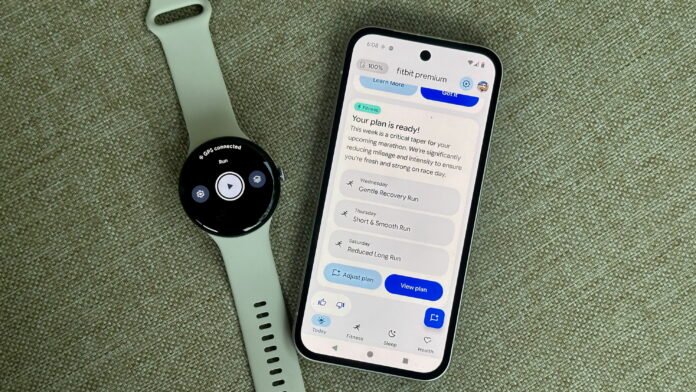
With Google, the Fitbit Personal Health Coach preview shows Google attempting to “keep up with fitness rivals,” with training plans for cycling, weightlifting, and other sports besides running, as I’d hoped. Plus, the Pixel Watch 4 got a nice boost with dual-band GPS.
However, I will admit that Wear OS 6 had more substantial UI and system changes than I’d expected with the advent of Material 3 Expressive.

I had a feeling that Gemini would not only blow up on Wear OS after taking over the Google Assistant but also become the Pixel Watch 4’s “killer app.” It’s not too surprising that Google made sure to give its smartwatch exclusive AI tricks: Raise to Talk and on-watch smart replies.
On the Galaxy Watch 8, I noted that I didn’t expect Samsung to use a squircle display, that we’d see a Galaxy Watch 8 Classic, and that Samsung would keep selling the Ultra before launching an Ultra 2 next year, all of which largely came true this year. However, I didn’t expect the Galaxy Watch 8 to ditch its usual rounded style for a squircle design, giving it its first major redesign in some time.

One good thing we saw this year was that Facer’s claim that it was “working hard with Google” to solve its Wear OS 5 ban wasn’t just corporate-speak: It partnered with Google to bring 3rd-party watch faces back to Wear OS 6, and they look great.
Unfortunately, not everyone was on board with Wear OS like I had hoped. It was wishful thinking that Motorola would return to Wear OS. We did see an HMD Global Wear OS leak this summer for two “Rubber” kids’ smartwatches, but they’ve yet to become official, and since HMD has abandoned American Nokia smartphone sales, I’m not sure if they’ll ever launch.

I also warned that Wear OS would continue to be plagued with slow updates from companies that aren’t Samsung and Google, particularly that Mobvoi would struggle to implement Wear OS 5 on TicWatches; turns out, Mobvoi may have stopped selling TicWatches for good. OnePlus was also not immune to slow updates, despite having one of the best Wear OS watches on the market, and it’s now months behind its promised Q3 update window for the Watch 2.
There were also no hardware updates for Fitbit watches in 2025, which is no surprise. While I knew I was “going out on a limb,” I thought Google might stop selling Fitbit hardware entirely — besides the Pixel Watch — and might expand its app to more watches. Instead, Google is promising new Fitbit hardware in 2026, so I’m thrilled to be wrong.
Google in 2025: B+

Looking back on Google’s year, it’s largely very positive. I gave the Pixel Watch 4 a glowing review and have continued to enjoy using it months later. Both my battery test and fitness test showed significant improvements over the last generation. Wear OS 6 impressed me with its overhauled UI, and the new Fitbit app is promising — though that’s more of a 2026 development.
While the main hardware launch gets an “A,” I have to knock Google for a few other developments. First, the Pixel Watch 1 didn’t get Wear OS 6, confirming that Galaxy Watches get at least one extra version update than Google’s, if not two. This lessens Pixel Watches’ long-term value.
The messy Wear OS 5.1 update in March proved that Google had some QC work to do, though later updates have been pain-free. My bigger complaint is about Google’s Wear OS stewardship: Mobvoi fleeing the platform in 2025, after Fossil left in 2024, suggests the “open” platform isn’t profitable enough for smaller, non-Android brands anymore.
We don’t have Pixel Watch 4 sales numbers, but Omdia‘s chart displays how Google’s wearable income since 2022 have peaked in each fourth quarter, and we will suppose the Watch 4 will hit a brand new prime, given its very good {hardware} and sure person opinions up to now.
Samsung in 2025: B

Samsung is constantly some of the most sensible smartwatch manufacturers international, however its gross sales dipped dramatically in Q1 2025 and haven’t fully recovered. Omnia displays Samsung wearable gross sales climbed this autumn, however Samsung nonetheless misplaced 2% marketplace proportion, whilst Counterpoint tracked a 5% marketplace drop for Samsung smartwatches within the final quarter.
You can blame a couple of elements, like a lackluster Galaxy Watch 7 technology or Huawei stealing Samsung’s global marketplace proportion. It is sensible that Samsung took a large swing with the Watch 8 and Watch 8 Classic designs, seeking to recapture shopper hobby, and reversing its falling developments could be a long-term mission.
My colleague Brady loves how thin and light-weight his Watch 8 is, and says folks mustn’t disregard the squircle design as unpleasant till they see it in particular person. I additionally like my Classic’s rotating bezel and scale border, however I’m extra lukewarm on its cumbersome weight and smaller show. The Ultra (2025) is just value bringing up, with the inexpensive fashions stealing the Ultra’s glance, 3rd button, and brighter show.
I respect Samsung’s dogged resolution to trace as many well being metrics as conceivable. On the health facet, the Running Coach and the brand new iFit video workout routines would possibly not wow any person.
I’m extra passionate about Samsung’s spin-off of Wear OS 6, One UI 8 Watch, which provides very good Tiles and the helpful Now Bar along new watch faces and an potency spice up. And with the Galaxy Watch 4 anticipated to obtain the replace earlier than EOY, Samsung has established itself as the simpler possibility for tool strengthen over Google.
OnePlus in 2025: B-

Speaking in particular about OnePlus’s Wear OS fashions, I’m much less enthused than I used to be previous within the 12 months. Things began out sturdy with the OnePlus Watch 3: Its battery life is unprecedented for a true smartwatch, it fixed several flaws in the last model (such as adding a functional crown), and it has a classy titanium look.
Yes, the “Meda in China” typo delayed its launch into April, but that was a nothingburger. And OnePlus followed up by launching a Watch 3 43mm in July, and while the signature battery life has shrunk, it still lasts two days, the same as the Pixel Watch 4 45mm.
The bigger issue concerns the OnePlus Watch 2 and Watch 2R. OnePlus Watches are due to receive two OS updates, but these 2024 models are still stuck on Wear OS 4 — two versions behind the competition — delayed from OnePlus’s promised Q3 2025 update window for Wear OS 5. I thought OnePlus would be better than Fossil and Mobvoi at promptly updating its watches, and I’m concerned that history is repeating itself.
Then we ended the year with the OnePlus Watch Lite, which I hoped would be a cheap Wear OS watch; instead, it’ll use a proprietary OS, similar to the original OnePlus Watch. This doesn’t guarantee that OnePlus will abandon Wear OS for good, but it does feel like another warning sign.
Source: www.androidcentral.com