

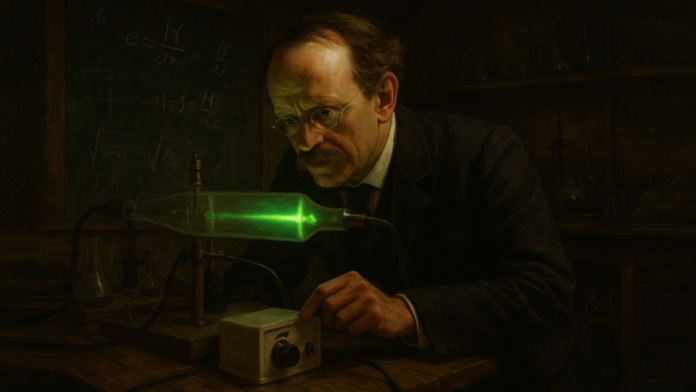
Joseph John Thomson—“JJ” as he was once referred to as—may just rarely have identified that what flickered sooner than him would redefine the rules of science.
Within months, the sector would be told of a particle so small it was once invisible, but so robust it could gentle towns, shrink computer systems, and break up atoms. The electron had entered human historical past.
JJ Thomson was once a lot more than the person at the back of the invention of the electron. His tale may be a few modest guy with an ordinary thoughts, a mentor whose scholars went directly to win extra Nobel Prizes than any trainer sooner than or since, and a determine whose legacy reaches into each twine, display screen, and microchip we contact lately.
THE MANCHESTER PRODIGY
JJ Thomson was once born on December 18, 1856 in Cheetham Hill, a suburb of Manchester, into a global nonetheless humming with the power of the Industrial Revolution.
His father, a bookseller, was hoping younger Joseph would sooner or later apprentice as an engineer. But engineering required pricey apprenticeships, and the loss of price range following his father’s loss of life compelled Thomson to pursue scholarships and educational find out about.
Instead, the boy’s ability for arithmetic led him in opposition to a scholarship at Owens College, Manchester, in 1870, the place his fascination with physics took root.
Those who knew him in those early years described him as shy, even frail-looking, with a quiet depth that surfaced when he spoke about science.
By 1876, Thomson had secured a scholarship to Trinity College, Cambridge — a price ticket into probably the most intellectually fertile floor of Victorian Britain.
THE CAVENDISH YEARS AND THE ELECTRON
The Cavendish Laboratory at Cambridge was once the place Thomson in reality got here into his personal. Appointed Cavendish Professor of Physics in 1884 at simply 28 years outdated, he inherited a laboratory identified for experimental ingenuity.
Yet it was once within the mid-Nineties, when he became his consideration to cathode rays—mysterious beams produced in vacuum tubes—that he etched his title into historical past.
Through painstaking experiments, Thomson confirmed that those rays weren’t waves of sunshine or disturbances within the ether, as many had believed, however streams of negatively charged debris.
By measuring their deflection in magnetic and electrical fields, he calculated their charge-to-mass ratio and located them a ways smaller than any atom identified. “We have right here,” he informed the Royal Institution in 1897, “a brand new more or less subject, smaller than atoms themselves.”
It was once a revelation. The indivisible atom of physicist John Dalton and Ancient Greek thinker Democritus have been damaged open, its hidden structure published.
Newspapers of the time when compared the invention to Columbus sighting the New World. The electron, regardless that invisible, had turn into a doorway to fashionable physics.
THE PLUM PUDDING MODEL
Yet science is never tidy, and Thomson’s interpretations of the atomic fashion mirrored the uncertainties of the age.
In 1904, he proposed his now-famous “plum pudding” fashion of the atom: a definitely charged sphere studded with electrons like raisins in a pudding.
Though later supplanted via Ernest Rutherford’s nuclear fashion, it marked the primary severe try to describe atomic construction.
The plum pudding atom might sound old fashioned lately, however on the time it was once innovative. It gave researchers a kick off point to believe how atoms may well be constructed, and it supplied a springboard for the experiments that may later resolve the actual complexity of atomic nuclei and quantum mechanics.
MENTOR TO A GENERATION OF NOBELISTS
Perhaps simply as exceptional because the electron was once Thomson’s present as a mentor. He had a steady, encouraging taste that set him with the exception of extra domineering professors.
His scholars flourished below his steerage, and between them they might earn no fewer than seven Nobel Prizes in physics and chemistry, along with his son profitable an extra 8th afterwards.
Among them was once Ernest Rutherford, who overturned his mentor’s plum pudding fashion with the invention of the atomic nucleus, and others equivalent to Lawrence Bragg and Charles Barkla, who made lasting contributions to physics.
It is attention-grabbing to notice that Niels Bohr, a scholar Rutherford, went directly to craft the primary quantum fashion of the atom.
A Cambridge funny story of the generation stated, “Of the sector’s Nobel Prize winners in physics, part had been taught via JJ Thomson, and the opposite part via his scholars.”
THE NOBEL PRIZE AND RECOGNITION
In 1906, Thomson himself was once awarded the Nobel Prize in Physics “in reputation of the good deserves of his theoretical and experimental investigations at the conduction of electrical energy via gases.”
The quotation may have sounded modest, however at the back of the ones phrases lay the invention that modified physics endlessly.
The honour was once offered via the Royal Swedish Academy of Sciences in Stockholm, a ceremonial second that positioned him a number of the giants of physics.
A QUIET LIFE, A HUMBLE MAN
Despite his world-changing discoveries, Thomson remained remarkably humble. Colleagues recalled him as mild, modest, and deeply spiritual in a quiet method.
He married Rose Paget, the daughter of the Regius Professor of Medicine, and in combination that they had two youngsters.
Their son, George Paget Thomson, would sooner or later win the Nobel Prize himself for demonstrating the wave-like nature of the electron—a virtually poetic continuation of his father’s paintings.
While JJ Thomson unveiled the particle nature of the electron in 1897, George, 4 a long time later, proved that electrons may just additionally behave like waves, diffracting thru skinny motion pictures just like gentle.
It was once a revelation that cemented the bizarre duality on the middle of quantum mechanics, and in some sense, father and son had mapped out two facets of the similar thriller.
In his spare time, Thomson loved writing and was once identified for his transparent, virtually literary explanations of physics.
His books, equivalent to Conduction of Electricity thru Gases, and Elements of the Mathematical Theory of Electricity and Magnetism, had been extensively learn and changed into classics of early Twentieth-century physics.
ANECDOTES THAT LINGER
Stories about Thomson abound in Cambridge lore. One tells of the way he would shuffle into the laboratory in worn-out footwear and with chalk mud on his coat, so absorbed in concept he would fail to remember to devour.
Another remembers his endurance with suffering scholars; when one younger researcher by accident broke a precious piece of apparatus, Thomson is claimed to have gently remarked, “Now we all know a method to not do it.”
Perhaps probably the most putting anecdote comes from his Nobel acceptance. He devoted the prize to not his personal genius however to the collaborative spirit of the Cavendish Laboratory, emphasising that science, like existence, was once by no means the paintings of 1 individual by myself.
THE FINAL YEARS AND LEGACY
Thomson died on August 30, 1940, on the age of 83, in Cambridge. He was once buried in Westminster Abbey, just about the graves of Isaac Newton and Charles Darwin—a last resting position amongst giants.
Today, each flicker of a pc display screen, each buzz of a smartphone, each hum of electrical energy carries the mark of JJ Thomson’s electron.
His discovery no longer best cracked open the atom however lead the way for the quantum revolution, the transistor, and the virtual age.
In the top, JJ Thomson was once no longer a person of fireworks however of quiet brilliance. He lived merely, mentored generously, and left at the back of a legacy that hums during the circuits of our global.
The shy boy from Manchester had unlocked one of the vital universe’s maximum elementary secrets and techniques—and in doing so, gave humanity the equipment to grow to be itself.
– Ends
Source: www.indiatoday.in